

GST vs VAT: What Commerce Students Need to Understand
Taxes like VAT and GST are a big part of how business and commerce work. If you’re studying commerce, knowing how this works, and how they differ, is very useful. Let’s break them down clearly, with comparisons, advantages/disadvantages, and some real data from India.
Table of Content:
1. What are VAT and GST?
1.1 VAT
1.2 GST
2. Key Differences Between VAT and GST
3. Why Was GST Introduced? What Problems Did It Solve?
3.1 Cascading Tax Effect (tax on tax)
3.2 Fragmented Regulations of States
3.3 Complexity of Compliance and Paperwork
3.4 Barrier to Interstate Trade
4. Advantages and Disadvantages: What Students Should Know
5. What Commerce Students Should Pay Extra Attention To
6. Changing the Way We Pay
7. Frequently Asked Questions
1. What are VAT and GST?
The government imposes two distinctive kinds of taxes on bought and sold goods and services; value-added tax (VAT) and goods and services tax (GST). Understanding how these taxes operate expands the student's understanding of business, pricing and trade, in a more expansive way. Let's explore the definition of VAT and GST.
Taxes like VAT and GST are part of how governments collect revenue from the sale of goods and services. Understanding them helps students see how business pricing, compliance, and trade work in real life. Let’s break down each system to understand their differences and why GST replaced VAT.
1.1 VAT
Value Added Tax (VAT) was collected on every good each time that it passed from one phase of the supply chain to another, such as from manufacture to wholesale, and then from wholesale to retail. Tax was added each time to the value that was created. While that allowed tax collectors to provide controls over their taxes, there was often a situation where the same good was taxed more than once, jacking up the price for their ultimate customers. And as VAT collection was managed at each state, the structure of rules and rates for taxes were different, which contributed more complexity around how businesses were able to operate in multi-state jurisdictions.
1.2 GST
Goods and Services Tax (GST) was created to simplifying taxes. GST is unique because it covers goods and services so they are treated under one tax umbrella which has several advantages over VAT. GST is a single tax system where businesses can claim GST credits for the stage before so the complications of "tax on tax" are mostly avoided. Another major benefit of GST is that rules are relatively uniform across states, making it easier and clearer for business operations.
2. Key Differences Between VAT and GST
Here’s a table comparing VAT vs GST under major heads, especially as they work in India.

3. Why Was GST Introduced? What Problems Did It Solve?
GST isn't a tax: it was intended to resolve multiple issues from the previous system. Including, but not limited to the following:
3.1 Cascading Tax Effect (tax on tax)
Under VAT + service tax + excise, the same product could have multiple taxes applied to it as it flows through manufacturing → wholesaling → retailing. When product is sold, GST will allow for the tax that has already been paid to be credited, so that the overall tax paid by a business is applicable towards excise, sales, and service tax.
3.2 Fragmented regulations of states
Various states applied different VAT rates, definitions, etc. This made doing business sometimes complex if doing business across state boundaries. While GST certainly isn't uniform across the country (it is still own-state-determined), it brings about a more uniform regulation.
3.3 Complexity of compliance and paperwork
The previous system had various laws, different tax returns/forms, and was in many cases not online. GST combines many processes under one online system versus ONE registration process, etc.
3.4 Barrier to Interstate Trade
Goods being shipped from one state to another faced a barrier to trade (i.e. monitored checks, taxes, etc.) and were subject to costs and time limitations arising from these instituted barriers. GST will effectively remove some of those barriers.
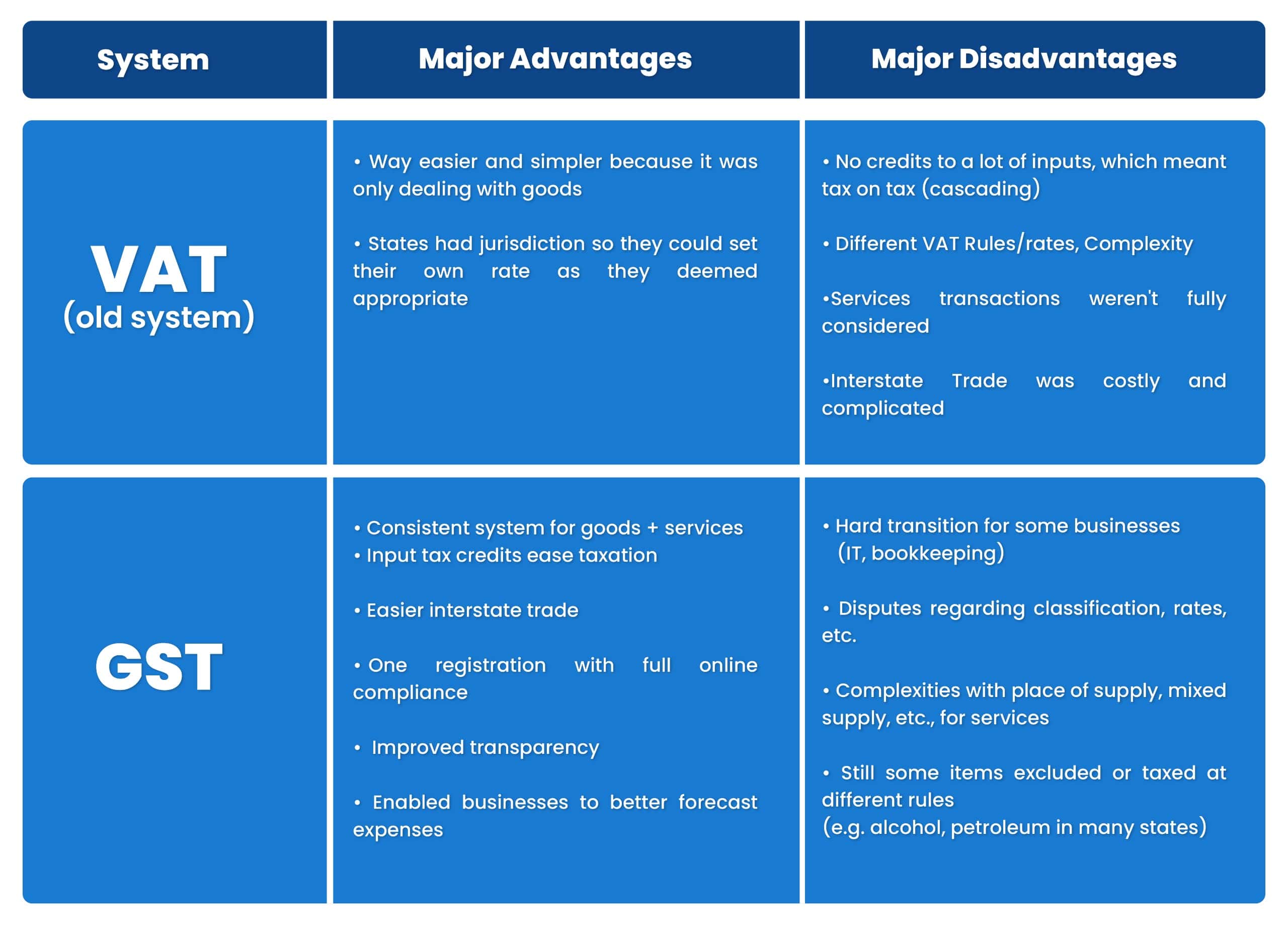
4. Advantages and Disadvantages: What Students Should Know
Here are pros and cons of both systems (especially in Indian context). This helps in exam questions or real life cases.
5. What Commerce Students Should Pay Extra Attention To
- Input Tax Credit (ITC): Understand how it works under GST vs how limited it was under VAT. In many questions, ITC is key to finding net tax liability.
- Taxable event / supply chain: Under VAT, sales of goods; under GST, supply of goods or services. Also things like inter-state vs intra-state supply are important.
- Rates and classification: Under GST, many slabs; the classification of goods/services matters a lot (for example, same item may fall under different rate if service component is included). In VAT era, state rates could differ wildly.
- Legal basis / change over time: Know when GST was introduced, constitutional amendment, which taxes got subsumed etc.
- Practical implications: for business (pricing, invoices), for consumer (final price), for government (revenue, compliance), and for trade across states.
6. Changing the Way We Pay
While both VAT and GST are intended to collect tax on the supply of goods and services, they do so in completely different ways. VAT was often limited and variable, which meant confusion from one state to another, and created a higher price for customers due to multiple levels of taxation. While GST was intended to create one way to deal with tax, no limits, all goods and services, less ambiguity in claiming tax credits and eliminate “tax on tax.” If commerce students walk away only knowing that GST is a more structured, transparent, and business-positive method of taxation than VAT, that is enough. It is important to not only understand these differences for your assessments, but to follow how every transaction has a part of taxation in it, and thus has potential implications for trade, decision-making and the price paid when we start our day!
7. Frequently Asked Questions
1. Is the VAT the same as GST?
No. VAT only applied to goods and was collected at every stage of the supply chain. GST, on the other hand, covers both goods and services under one system, making it more uniform and easier to manage.
2. Is VAT still allowed in India?
For most products and services, VAT has been replaced by GST. However, some items like petroleum products and alcohol are still taxed under VAT by state governments.
3. What are the three types of VAT?
The three types of VAT are:
- Consumption VAT – tax is collected on what people spend.
- Income VAT – tax is collected on income earned after savings.
- Production VAT – tax is collected on the total value produced, without deductions for wages or depreciation.
4. Has GST replaced VAT in India?
Yes, GST has largely replaced VAT since 2017. Now, GST is the main indirect tax system in India, except for a few goods like petroleum and alcohol which remain under VAT.
We’re Featured On
Recognized by leading media houses for our commitment to quality education and student success.


