

What is IFRS and Why Does It Matter in Global Accounting?
In the current global business environment, companies conduct business across national borders, raise capital from public markets that are located across national borders, and connect with investors from across national borders. If each country doesn't have a way of doing financial reporting of business activities that follows the country's own style of accounting, reliance on the accuracy of financial statements becomes difficult, and comparing financial statement becomes pointless. This is why the world needs a common financial language - systems that assure financial reports are prepared the same way everywhere. This is where IFRS comes in.
Table of contents:
1. What is IFRS?
2. Who Creates IFRS?
3. Why Does IFRS Matter in Global Accounting?
4. IFRS in Accounting: Simple Example
5. Where is IFRS Commonly Applied?
6. Benefits of Using IFRS
7. IFRS vs Local Accounting Standards
8. Who Should Learn IFRS?
9. Frequently Asked Questions
1. What is IFRS?
The International Financial Reporting Standards (IFRS) are a set of accounting regulations that are recognized around the world. The standards are developed to allow for the preparation and presentation of financial statements that are clear, consistent, and comparable across a range of industries and countries. More simply put, IFRS in accounting is a global financial language that allows companies to report their performance in a manner that investors, regulators, and the general public can understand, regardless of the business location. IFRS reduces confusion, increases transparency, and provides stakeholders with information that allows for better decision-making.
2. Who Creates IFRS?
The IFRS Foundation, a non-profit organization based in London, develops and maintains the standards. The Foundation's primary objective is to promote transparency, accountability, and efficiency in financial markets around the world. It does so by developing standards that require transparent and comparable information in financial statements for investors, businesses, governments, and the public.
Before IFRS, there was no global accounting system that people could follow and there were very different accounting systems in individual countries which was confusing.
For example:
- A company in India and a company in Germany both report that they are profitable.
- However, the method for determining if they were profitable may have been quite different.
- IFRS provides a solution to this problem by establishing a common language for financial reporting.
3. Why Does IFRS Matter in Global Accounting?
Here’s why IFRS is so important today:
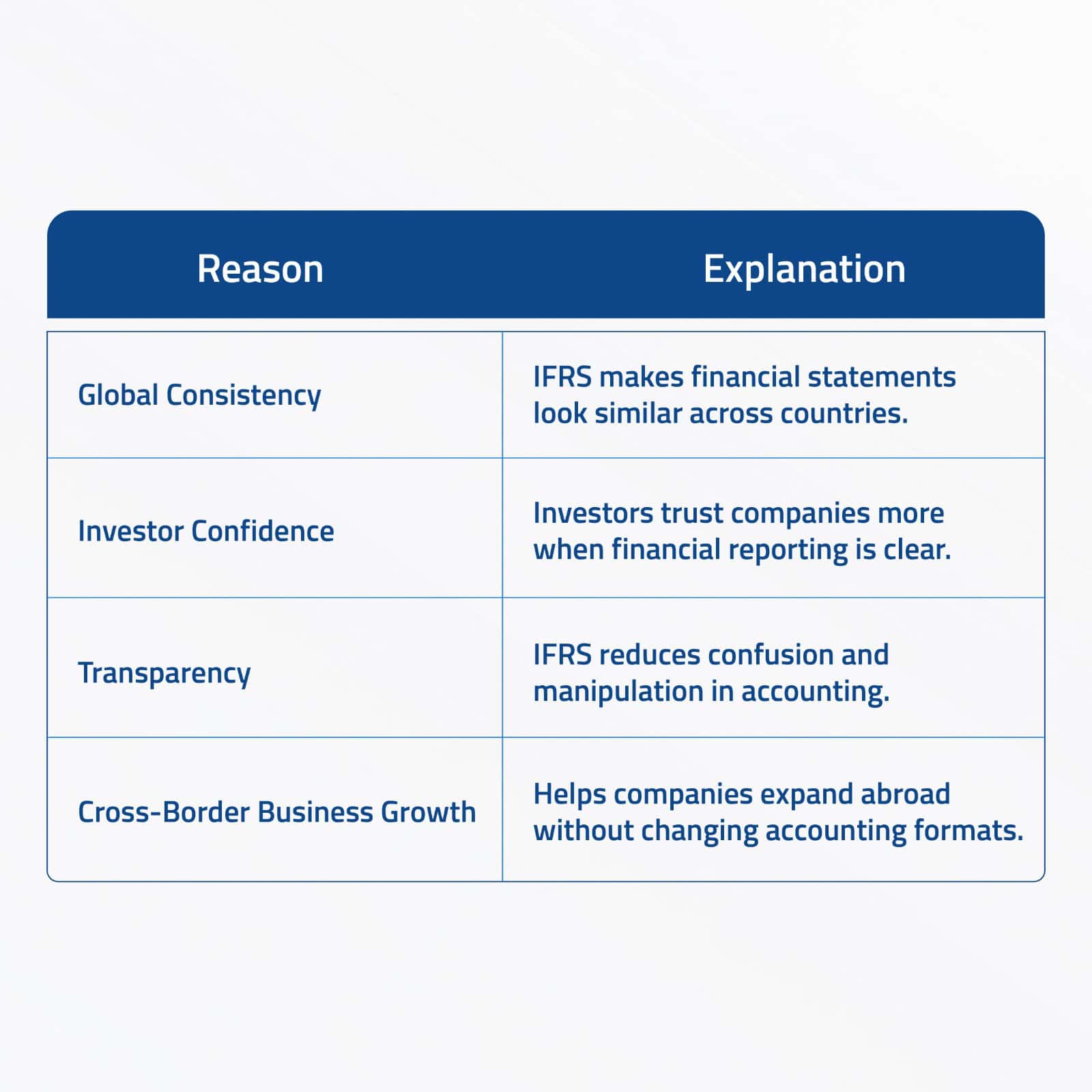
Today, 140+ countries use or permit IFRS — making it the global standard.
4. IFRS in Accounting: Simple Example
Let's say you run a business that sells products to customers.
Under IFRS:
In order for you to recognize revenue, you must have delivered the product or service; it is not just about collecting your cash from the customer. This requirement was established to allow profit to truly represent performance, and not just cash flow. The 'delivery' of the product was defined in IFRS 15 - Revenue from Contracts with Customers. IFRS 15 defines the revenue recognition standards for IFRS.
5. Where is IFRS Commonly Applied?
IFRS is primarily utilized by:
- Publicly traded companies (companies listed on stock exchanges)
- Multinational corporations
- Big 4 Firms
- Financial Institutions
- Shared Services
Even students studying ACCA, CA, CMA, MBA, and programs in Finance now engage IFRS early on.
6. Benefits of Using IFRS
- Builds confidence among investors
- Facilitates easy global financial comparison
- Facilitates access for companies to tap into international funding
- Enhances reporting accuracy and transparency
7. IFRS vs Local Accounting Standards
While certain nations, such as India, also follow a set of standards that closely match IFRS, this was primarily accomplished through Ind AS (Indian Accounting Standards), which is based on IFRS but adjusted for local economic and regulatory considerations. This means there may be some presentations or treatments that differ, but overall the principles and reporting goals align with those of IFRS.
For finance professionals, notably CA students, qualified CAs, and those employed in audit or financial reporting challenges, it is vitally important to acquire knowledge of IFRS and Ind AS. These two standards are used for compliance and reporting by most multinational companies, "Big 4" firms and by listed entities. Given IFRS past and prospective global dominance in corporate finance, IFRS knowledge will certainly position some finance professionals ahead of their peers or colleagues in corporations.
8. Who Should Learn IFRS?
- Students taking finance and accounting courses
- Students pursuing CA, ACCA, CMA, CPA
- Practicing in audit and taxation
- People working for multinational companies
IFRS will offer more job potential, particularly in:
- Big 4 (EY, Deloitte, KPMG, PwC)
- Global shared service centers
- Cross-border finance roles
- International business consulting
9. Frequently Asked Questions
1) What is IFRS and GAAP?
IFRS (International Financial Reporting Standards) is a global set of accounting standards used in many countries to ensure clarity and comparability in financial reporting. GAAP (Generally Accepted Accounting Principles) is the accounting system followed mainly in the United States. IFRS is more principles-based, while GAAP is more rules-based.
2) Is IFRS applicable in India?
India does not use IFRS directly. Instead, it follows Ind AS (Indian Accounting Standards), which are largely based on IFRS but slightly modified to suit Indian regulations and business conditions. So, while the name differs, the concepts and approach are closely aligned to IFRS.
3) What are the 4 principles of IFRS?
The core principles of IFRS focus on ensuring that financial information is relevant, reliable, comparable, and easy to understand. These principles help maintain transparency and trust in financial reporting.
4) What is IFRS meaning in accounting?
In accounting, IFRS refers to the standardized global framework for recording and presenting financial statements. It ensures that companies across different countries report their finances in a consistent and understandable way.
We’re Featured On
Recognized by leading media houses for our commitment to quality education and student success.


