

Why Do Finance Professionals Choose CMA USA Over MBA?
Every finance professional reaches a crossroads at some point. The moment usually comes after a few years of work, when growth begins to feel limited, and the next leap in career requires deeper knowledge, stronger credentials, and a way to stand out in a competitive market. Traditionally, an MBA has been seen as the popular route to move ahead. Yet in recent years, there has been a visible shift. More professionals are opting for a different qualification: the CMA USA course, a finance and accounting certification specifically designed for those who want to master financial decision making, management accounting, budgeting, and strategic planning.
If you have ever wondered why many people now prefer CMA USA over an MBA, the answer lies in the structure, duration, career growth, investment required, and the practical skills it offers. The CMA USA structure is built for finance roles that require precision, analysis, and strategic financial thinking. For many professionals, it feels like a more direct route to their goals, compared with the broader and more generalised approach of an MBA.
Let us break down why CMA USA stands out.
Table of contents:
1. Focused Learning that Matters in the Real World
2. Faster Completion Without Pausing Your Career
3. High ROI and a Far More Affordable Path
4. Career Growth and Global Opportunities
5. CMA USA vs MBA at a Glance
6. A Practical Choice for the Ambitious Finance Professional
7. Frequently Asked Questions
1. Focused Learning that Matters in the Real World
An MBA covers subjects across business functions. You learn finance, yes, but you also explore marketing, operations, supply chain management, organisational behaviour, and many other areas. This broader learning is valuable for someone looking to transition into general management roles. However, for someone who wants to build depth in finance, the MBA can feel scattered.
The CMA USA course is intentionally narrow in scope, and that is its greatest strength. It revolves around what truly matters in finance and management accounting. You learn cost planning, inventory valuation, risk management, variance analysis, budgeting techniques, performance metrics, internal control systems, and how to use financial information to guide business decisions. Instead of being introduced to many subjects at a surface level, you go deep into financial topics that drive business profitability.
Professionals who want mastery rather than breadth find the CMA USA structure efficient, logical, and more aligned with their career path.
2. Faster Completion Without Pausing Your Career
One of the biggest challenges with an MBA is time. A two-year program requires commitment, effort, and in many cases a complete break from work. For someone supporting a family or already progressing well in their job, taking a career break may not be feasible. The CMA USA course solves this problem.
Most candidates complete CMA USA within six to eighteen months. The flexibility of scheduling lets you study while working and continue earning your salary at the same time. You can grow academically and professionally together, instead of pausing one to develop the other. For many, this becomes the deciding factor because it removes the fears of income loss, delayed career progression, or a long gap in experience.
3. High ROI and a Far More Affordable Path
Education is an investment, and every professional today thinks carefully about return on investment. MBA programs can cost anywhere from several lakhs to tens of lakhs, along with the hidden cost of lost salary during the study period. CMA USA, on the other hand, is far more accessible. The entire certification, including learning resources and exams, costs just a fraction of what top Indian MBAs charge.
What makes this even more impressive is the salary growth that comes with certification. Reports show that job opportunities after CMA USA are strong and expanding. CMA professionals in India often see salary increases of 40% to 58%, depending on role, industry, and experience. Globally, CMAs earn about 21% more in median total compensation than non‑CMAs, with a global median of around $86,955.
When this is compared with the investment made, CMA USA often offers one of the highest ROIs among professional finance qualifications.
Over three years, a CMA USA certified professional can earn up to thirteen times the amount they spent on certification. This kind of financial return is rare to find.
4. Career Growth and Global Opportunities
Earning the CMA USA opens doors to senior roles faster because the qualification signals a high level of professional capability. Employers trust CMA professionals to analyse financial data, assess business risk, improve processes, and support decision-making at an organisational level. Many CMAs grow into roles such as Financial Analyst, Cost Controller, Finance Manager, Internal Auditor, and eventually CFO, depending on experience and performance.
The CMA USA scope goes far beyond local opportunities. The certification is valued worldwide and recognised in more than 140 countries. Unlike an MBA, where reputation depends heavily on institution ranking, CMA USA is standardised globally. Whether you want to work in India or pursue international placements, CMA USA enhances credibility and mobility.
In an increasingly global business environment, employers prefer candidates who can think financially, forecast efficiently, and make strategic recommendations. CMA professionals fit this requirement perfectly.
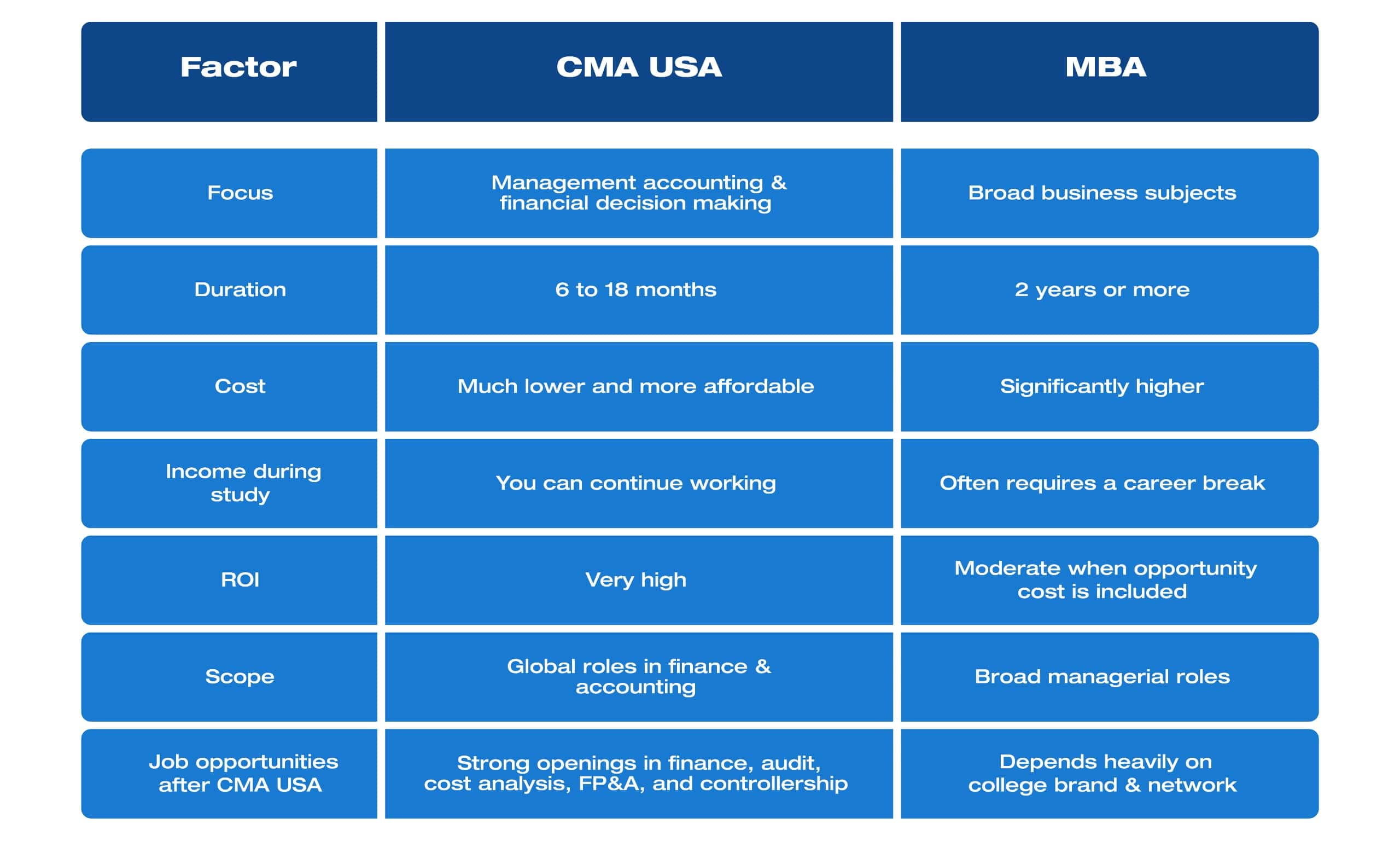
5. CMA USA vs MBA at a Glance
6. A Practical Choice for the Ambitious Finance Professional
When professionals compare both routes logically, many ultimately choose CMA USA because it appears to be a direct, efficient, and cost-effective path to career advancement. If your future revolves around finance, strategy, and decision-making, CMA USA aligns more naturally with your goals. The curriculum equips you with real-world financial skills, the duration is manageable for working individuals, and the ROI is remarkably high.
MBA is still a powerful qualification, especially for those interested in broader business roles. However, if your passion lies in finance, if you want to upskill without pausing your career, and if you are looking for global recognition that leads to tangible growth, the CMA USA course is a straightforward, smart, and impactful route.
7. Frequently Asked Questions
1) Is CMA losing value?
Not at all. CMA continues to hold strong value in today’s job market because companies still need experts who understand finance, cost control, and data-driven decision-making. As long as you build good practical skills along with the qualification, CMA remains a strong career option.
2) CMA or MBA, which is tough?
Both have challenges, but in different ways. CMA is more technical and exam-focused, while MBA demands projects, presentations, and long-term coursework. If you’re comfortable with numbers and structured exams, CMA may feel easier. If you enjoy management and teamwork, MBA might feel more natural.
3) Is CMA USA better than CMA India?
Each has its own purpose. CMA USA is globally recognised and ideal for careers in multinational companies and finance roles. CMA India suits students who want to specialise in cost accounting within India. Your choice should match your long-term career goals — global exposure or India-focused roles.
4) Will I get a job in India after CMA USA?
Yes. Many MNCs, Big 4 companies, and corporate finance teams in India hire CMA USA-qualified candidates. Your job opportunities improve further with practical skills like Excel, analytics, and internships.
We’re Featured On
Recognized by leading media houses for our commitment to quality education and student success.


