

ACCA vs CA: Which Is Better for Your Career in 2026?
In 2026, are you facing one of the most significant career turning points of your life? If you're a Class 12 student or a recent graduate trying to decide between ACCA and CA, this is more than just a course comparison; it's a choice that can affect where you work, how quickly you qualify, how much you make in your 20s, and whether your career stays focused on India or expands internationally. Though they are both strong, well-respected financial degrees, ACCA and CA are made for quite different study programs, career paths, and lifestyles.
This blog compares ACCA and CA in terms of difficulty, pay, global reach, recognition, and long-term growth so you can select the one that best suits your goals.
Table of Contents
1. Core Difference: India-focused vs Global-focused
2. ACCA vs CA Difficulty, Pass Rates & Study Experience
3. ACCA vs CA Salary in India and Abroad
4. Global Scope vs Indian Recognition
1. Core Difference: India-focused vs Global-focused
At the highest level:
- CA is India’s gold-standard qualification for taxation, audit, and compliance roles in the Indian regulatory system.
- ACCA is a global qualification recognised in 180+ countries, strong for multinational, IFRS-based, and cross-border finance roles.
Key Structural Differences
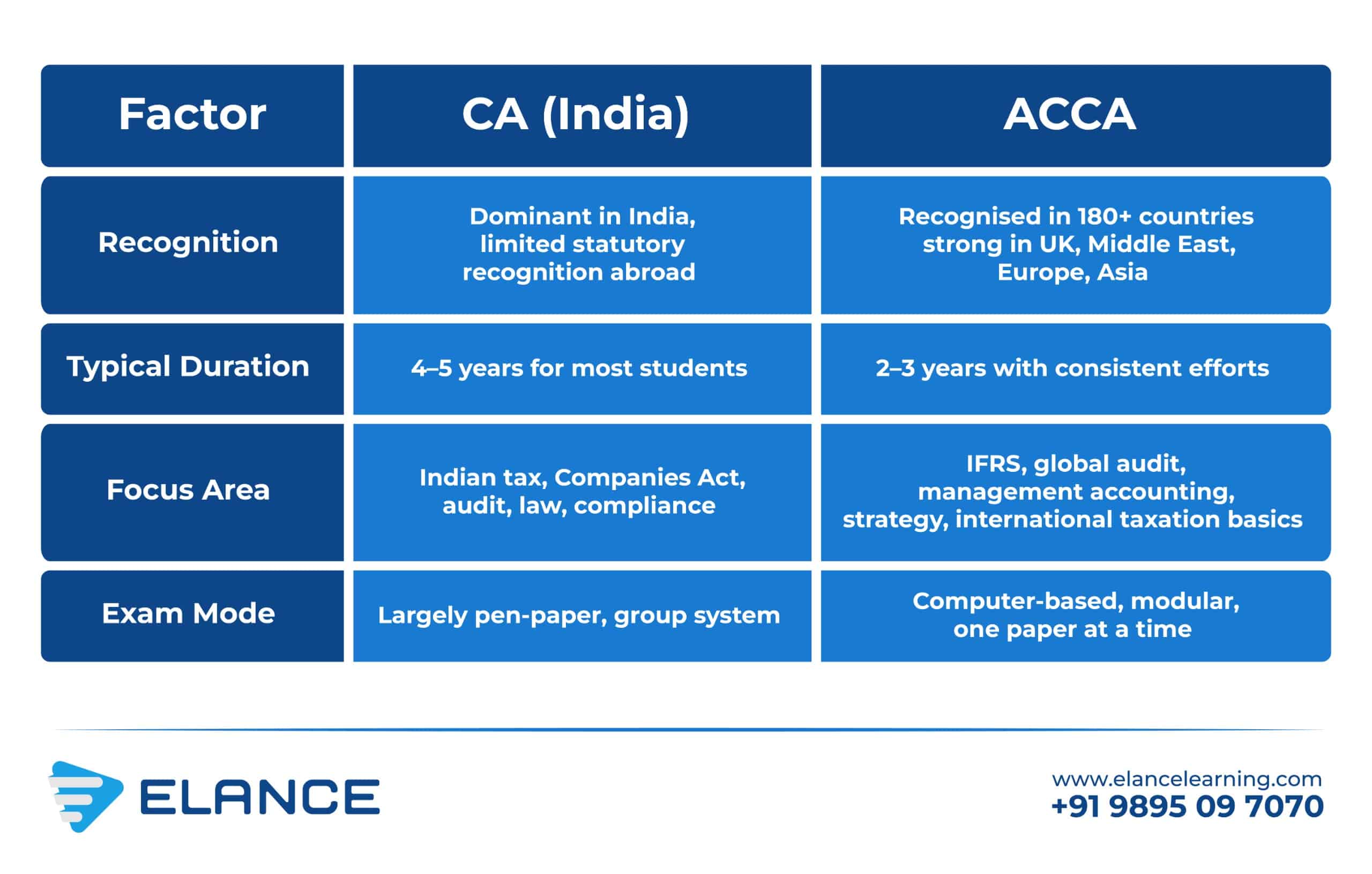
Why you should care: this is not about “better” in theory; it is about whether you want to build deep Indian practice expertise or a portable global finance profile.
2. ACCA vs CA Difficulty, Pass Rates & Study Experience
Pass Rates & Exam Pressure
- CA final-level pass rates often sit around 10–15%, and overall levels commonly range near 10–20%.
- ACCA exam pass rates for many papers hover around 40–55% globally, with 50% needed to pass each paper.
The gap is not because CA students are weaker, but because of structure:
- CA uses a group system, so you must clear multiple subjects together; failing one can pull down the entire group.
- ACCA lets you attempt one paper at a time, so you can focus, adjust, and move faster.
Practical Training & Lifestyle
- CA articleship is 3 years, often 35–50 hours a week, with high workload during audit/tax seasons while you also prepare for tough group exams.
- ACCA practical experience requirements are more flexible; students can often sequence work and exams to reduce burnout.
Why you should care:
If you like high-pressure, all-in challenges and are okay with longer timelines and repeated attempts, CA can suit you. If you want modular progress, more control over exam load, and computer-based, application-focused exams, ACCA will feel more manageable.
3. ACCA vs CA Salary in India and Abroad
Entry-level and Early Career (India)
Most recent comparisons show:
- CA freshers in India often start around ₹6–9 LPA.
- ACCA freshers usually see ₹4.5–7 LPA in India, with higher packages in Big 4 and MNC hubs like Bangalore.
With 5–10 years of experience:
- Many CAs move into ₹15–40 LPA brackets depending on role, city, and firm.
- ACCAs in India commonly reach around ₹12–35 LPA, and often more when they move into FP&A, global reporting, or regional roles in MNCs.
International Salary Potential
For roles in the UK, Middle East, or Singapore, ACCA typically has stronger recognition than Indian CA, and some benchmarks show higher average pay bands for ACCA profiles in overseas roles compared to CAs migrating laterally.
Why you should care:
- If your main target is a strong domestic salary and practice/consulting in India, CA has a slight salary edge in India-focused careers.
- If your plan includes working abroad or with global finance teams, ACCA’s overseas scope can outweigh the initial salary gap in India.
4. Global Scope vs Indian Recognition
Where CA Wins:
- Statutory audit and signing authority in India under Indian laws.
- Deep demand in Indian tax, audit, and compliance consulting.
- Strong brand value in traditional CA firms, banks, and corporates within India.
Where ACCA Wins:
- Global mobility across 180+ countries, especially UK, UAE, Singapore, EU.
- Roles in MNCs, Big 4 shared services, FP&A, global reporting, controllership, and finance transformation.
- Modern syllabus with IFRS, analytics, and business strategy integrated.
Why you should care?
Your “ACCA vs CA global scope” decision is basically: Do you want to be a go-to India expert, or a globally relevant finance professional who can easily plug into multinational teams?
5. Which Is Better for You: ACCA or CA?
Choose CA if:
- You want to build a long-term career in India.
- You see yourself in statutory audit, tax practice, or corporate compliance roles.
- You are okay with tougher pass rates, longer timelines, and intense articleship.
Choose ACCA if:
- You want global opportunities or to work with MNCs and cross-border clients.
- You prefer computer-based, modular exams and more predictable progression.
- You are comfortable investing slightly higher fees in exchange for faster completion and broader global scope.
What about ACCA + CA?
Some students eventually do both to combine Indian statutory strength with global recognition, but that is only realistic if you have strong discipline, time, and financial backing.
The right question is: which qualification matches where you want to work, how you like to study, and how quickly you need to start earning.
6. Frequently Asked Questions
1. ACCA or CA – which is better for salary in India?
For pure India-based roles, fresh CA salaries generally start a bit higher than ACCA, often around ₹6–9 LPA for CAs compared to roughly ₹4.5–7 LPA for ACCAs, though top MNC roles can narrow this gap.
2. ACCA vs CA difficulty – which is harder to clear?
CA is widely seen as tougher because of low pass rates, group-based exams, and demanding articleship, while ACCA has higher pass rates and modular exams that many students find more manageable.
3. Does ACCA have good scope in India in 2026?
Yes, ACCA demand is growing in Big 4, shared service centres, and MNC finance teams in India, especially for roles linked to IFRS and global reporting, though it still does not replace CA for statutory work.
4. Can I sign audit reports in India as an ACCA?
No, only CAs registered with ICAI have statutory signing powers for most regulated audits in India, while ACCAs can still work in audit teams, internal audit, and advisory roles.
We’re Featured On
Recognized by leading media houses for our commitment to quality education and student success.


