
 Can You Work in 180+ Countries With ACCA? Here’s the Honest Answer
“ACCA is recognised in 180+ countries” appears on almost every ACCA brochure. But what does that actually mean for you as a student or working professional in Kerala? Can you just pack up and get a finance job anywhere in the world? This guide gives you the honest, practical answer, including the one distinction most people miss, so you can plan your international career with realistic expectations.
Table of content
1. What does “recognised in 180+ countries” actually mean?
2. Recognition vs signing authority — the distinction that matters most
3. Where is ACCA strongest? A regional breakdown
4. Which roles can you target abroad with ACCA?
5. ACCA vs CMA USA: Which is better for working abroad?
6. How to plan your ACCA journey if you want to work abroad?
1. What does “recognised in 180+ countries” actually mean?
It means employers and regulators in those countries understand what ACCA is, what its syllabus covers, and what standard of competency an ACCA member or student has reached. That is genuinely valuable, your CV does not reset to zero every time you cross a border.
In practical terms, recognition means easier shortlisting for finance roles, smoother conversations during work visa applications, and the ability to move between markets, whether that’s from India to the UAE, the UAE to Singapore, or Singapore to the UK, without having to re-explain or re-prove your qualification to every employer.
According to ACCA Global, there are currently over 252,500 ACCA members and 526,000 students worldwide, with more than 7,400 approved employers actively recruiting from this pool. That community presence is what makes the qualification portable in a way that purely domestic qualifications are not.
(In boxes)
252,500+ members globally | 526,000 students worldwide | 7,400+ approved employers | Recognised in 180+ countries
2. Recognition vs signing authority the distinction that matters most
The most common misconception: “If ACCA is recognised in 180+ countries, I can sign audits anywhere.” This is not true, and it’s important to understand why before you plan your career.
Recognition for employment and legal signing authority are two completely different things. Statutory audit signing rights are governed by each country’s local laws, not by ACCA’s global recognition. In most countries, to sign off on a statutory audit you need either local membership, a mutual recognition agreement, or additional country-specific exams, on top of your ACCA qualification.
Think of it this way: ACCA is your base global qualification that gets you in the door for finance roles almost anywhere. If you want to practise as a signing auditor in a specific country, you typically “top up” with local requirements for that geography.
For the majority of ACCA professionals, working in financial reporting, management accounting, FP&A, compliance, and commercial finance, this distinction rarely matters in practice. It primarily affects those specifically targeting statutory audit roles in regulated markets.
3. Where is ACCA strongest? A regional breakdown
ACCA’s recognition is not uniform across all 180+ countries, it is significantly stronger in some regions than others. Here is where it genuinely opens doors for employment and professional roles:
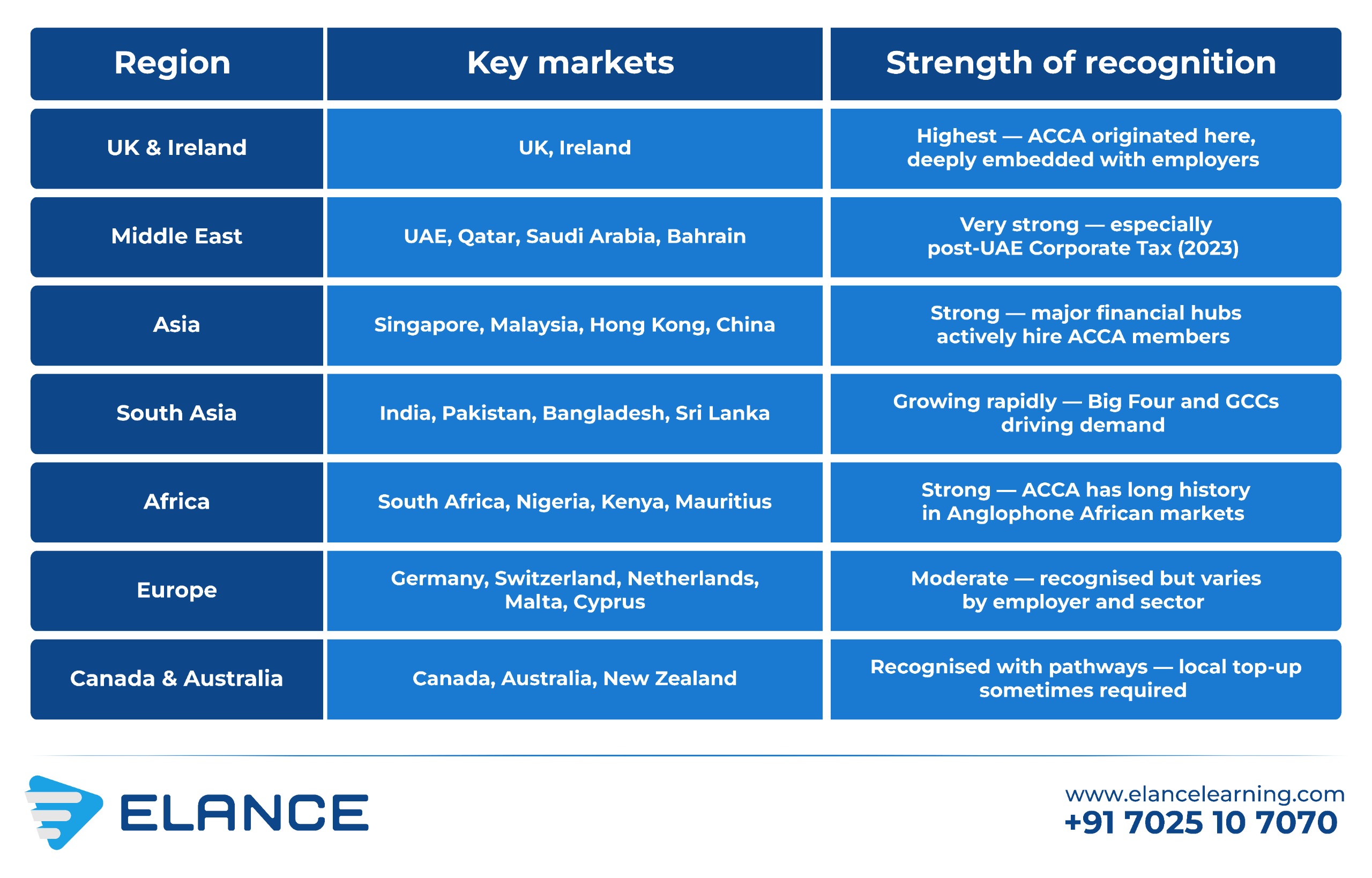 For Kerala students specifically, the Middle East, particularly the UAE, represents the most accessible and highest-demand market. ACCA is one of the most recognised finance qualifications among UAE employers, and the post-2023 corporate tax environment has made qualified accountants significantly more sought after.
4. Which roles can you target abroad with ACCA?
ACCA’s syllabus is built around IFRS, audit, taxation, performance management, and strategic finance — all of which are directly aligned to global corporate needs. This is why Big Four firms, banks, MNCs, and consulting firms hire ACCA students and members across multiple countries.
- Financial analyst and management accountant roles in MNCs and shared service centres.
- FP&A, business partnering, and commercial finance roles in large corporates.
- Audit and assurance roles in Big Four and mid-tier firms (subject to local regulations).
- IFRS reporting roles in international captive centres and holding companies.
- Compliance and risk roles — especially in markets with new regulatory frameworks like the UAE.
Crucially, ACCA experience is transferable. If you spend 2–3 years in an IFRS-based reporting role in India, an employer in Singapore or the UK can directly assess that experience. You are not starting from scratch, which is the real value of a globally recognised qualification.
5. ACCA vs CMA USA: Which is better for working abroad?
This is one of the most common questions students in Kerala ask. Here is a straight comparison from a global mobility perspective:
ACCA
Best for global mobility
Explicitly designed for international recognition. Accepted in 180+ countries. Strong mutual recognition agreements with local bodies in the UK, Australia, Canada, and others. Ideal if your goal is to work across multiple geographies over your career.
CMA USA
Best for management accounting
Strong in the US, Middle East, and parts of Asia for management accounting and FP&A roles. Two exams only, faster to complete than ACCA. Narrower in scope but highly respected in specific sectors like manufacturing and financial services.
6. How to plan your ACCA journey if you want to work abroad?
Global mobility with ACCA does not happen by accident, it requires planning from early in your journey. Here is a practical roadmap:
1. Choose your optional papers with your target region in mind
ACCA’s Strategic Professional level allows elective choices. If you are targeting the UAE, understanding taxation and financial reporting in that context matters. If you want the UK, Advanced Audit and Assurance is worth prioritising.
2. Build experience in internationally connected organisations from the start
Big Four firms, large Indian MNCs, GCC-headquartered companies, and global shared service centres all give you experience that is directly legible to overseas employers. Avoid building your entire career in a purely local firm if global mobility is your goal.
3. Target affiliate or membership before applying abroad
Most overseas employers require at minimum ACCA affiliate status, meaning all 13 exams completed. Some markets, particularly Singapore and the UK, are more receptive to candidates with full membership plus 3+ years of experience.
4. Research visa routes early
The UAE offers employment visas relatively straightforwardly for finance professionals. The UK’s Skilled Worker visa includes accounting roles and ACCA membership typically meets the skills threshold. Australia’s MLTSSL lists accounting as a skill in shortage. These are realistic pathways, but they require planning, not last-minute research.
5. Network within the ACCA community
With 252,500+ members globally, ACCA’s professional network is one of its underused assets. LinkedIn groups, ACCA’s official events, and local ACCA chapters in your target country are genuine sources of referrals and inside knowledge on hiring markets.
Thinking about using ACCA to build a career in the UAE, UK, or elsewhere? Our counselors at Elance Learning can help you map out a study and career plan based on your specific goals.
7. Frequently Asked Questions
1. Does ACCA give me signing authority in all these countries?
No, legal signing authority is controlled by each country’s regulator, so ACCA alone does not automatically give you audit signing rights in all 180+ countries.
2. Which regions are currently the best for ACCA jobs for Indian students?
The UK, Middle East (especially UAE, Qatar, Saudi), Singapore, Malaysia, and some European and African markets are particularly active in hiring ACCA qualified professionals.
3. Can I combine ACCA with CA or CMA?
Yes, many professionals combine ACCA with local CA, CPA, or CMA to maximise both domestic practice rights and international mobility, often using mutual recognition or exemption pathways where available.
4. At what stage of ACCA can I realistically start applying for roles abroad?
Typically, once you clear core ACCA papers, gain 1 to 2 years of solid experience, and move closer to membership, you are in a stronger position to be considered for overseas roles or internal transfers.
We’re Featured On
Recognized by leading media houses for our commitment to quality education and student success.


